
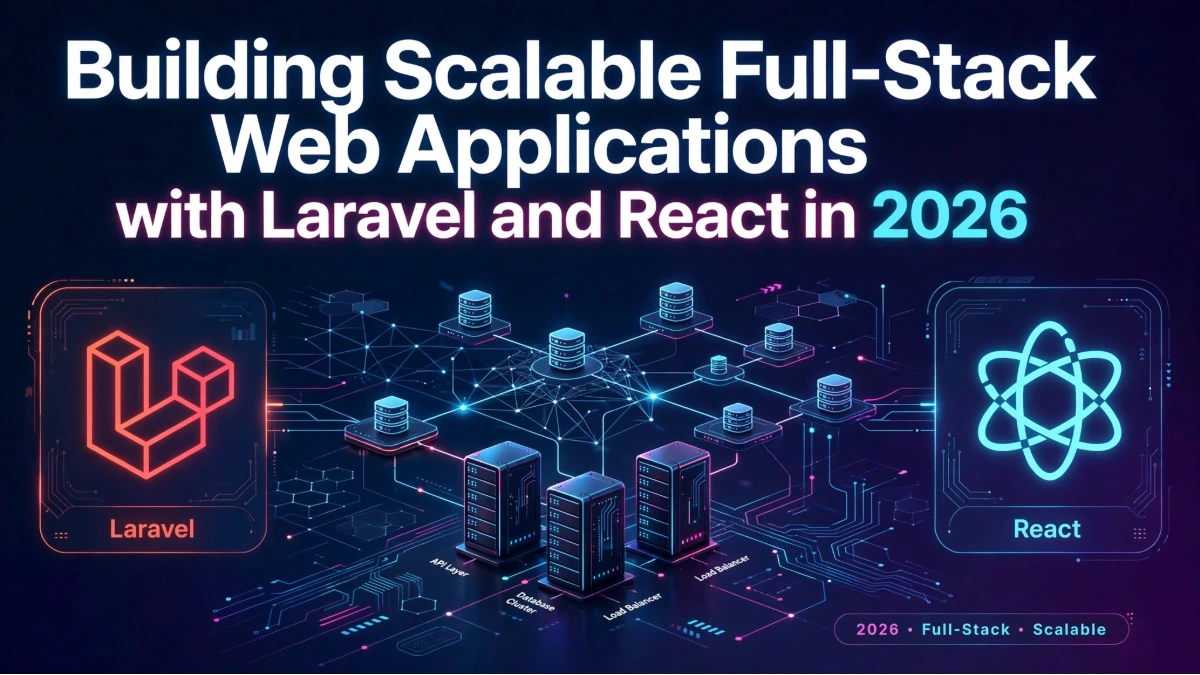
Building Scalable Full-Stack Web Applications with Laravel and React in 2026
Introduction
In today's fast-paced digital landscape, building web applications that are both robust on the backend and lightning-fast on the frontend is crucial for success. Developers constantly look for tech stacks that offer high productivity, seamless scalability, and exceptional user experience.
Combining Laravel (the PHP framework for web artisans) with React (Meta's powerful library for building user interfaces) creates one of the most potent full-stack combinations available today. In this comprehensive guide, we will explore how to architect, develop, and optimize a modern full-stack application using Laravel and React.
Why Choose Laravel & React in 2026?
The combination of Laravel and React brings together the best of both worlds:
- Robust Backend Architecture: Laravel provides elegant syntax, built-in authentication, robust database management via Eloquent ORM, and powerful queue management.
- Dynamic Frontend Ecosystem: React enables component-driven development, virtual DOM rendering for superior performance, and a rich ecosystem of UI libraries.
- Flexible Integration: You can choose between a decoupled API-driven architecture (Laravel as a REST/GraphQL API + Vite/React SPA) or a monolithic hybrid approach using Inertia.js.
Choosing Your Architecture: API vs. Inertia.js
Before writing code, you need to decide how your frontend and backend will communicate:
1. Decoupled Architecture (API + SPA)
In this setup, Laravel acts purely as an API provider (using Laravel Sanctum for authentication), while React runs independently as a Single Page Application (SPA). This is ideal if you plan to scale your backend to serve mobile apps or multiple frontends later.
2. Monolithic Integration (Inertia.js)
If you want the speed of a Single Page Application without the complexity of managing separate API endpoints and CORS, Inertia.js allows you to build single-page React apps using classic Laravel routing and controllers.
Step-by-Step Implementation Overview
Step 1: Setting Up the Laravel Backend
Start by creating a new Laravel project and configuring your database environment variables in the .env file:
composer create-project laravel/laravel aman-project-app
cd aman-project-app
php artisan key:generate
Step 2: Integrating React with Vite
Laravel comes out-of-the-box with Vite, making frontend asset bundling extremely fast. Install React and the Vite React plugin:
npm install --save-dev @vitejs/plugin-react react react-domConfigure your vite.config.js to include the React plugin, and set up your entry point in resources/js/app.jsx.
Step 3: Creating API Endpoints and Controllers
Build clean RESTful controllers in Laravel to handle business logic and return JSON responses or resource collections:
php artisan make:controller Api/PostController --apiPerformance & Security Best Practices
- Database Indexing: Ensure frequently queried columns in MySQL/PostgreSQL are properly indexed to reduce latency.
- Caching: Leverage Laravel Cache and Redis to cache heavy query results and configuration settings.
- State Management & Validation: Use robust form validation on both the frontend (React Hook Form + Zod) and backend (Laravel Form Requests) to secure user data.
Conclusion
The Laravel and React stack empowers developers to build feature-rich, scalable, and maintainable web applications efficiently. Whether you choose a traditional API-driven approach or leverage Inertia.js, this combination remains a top-tier choice for modern web development.
What is your preferred approach for full-stack development? Let us know your thoughts in the comments below!